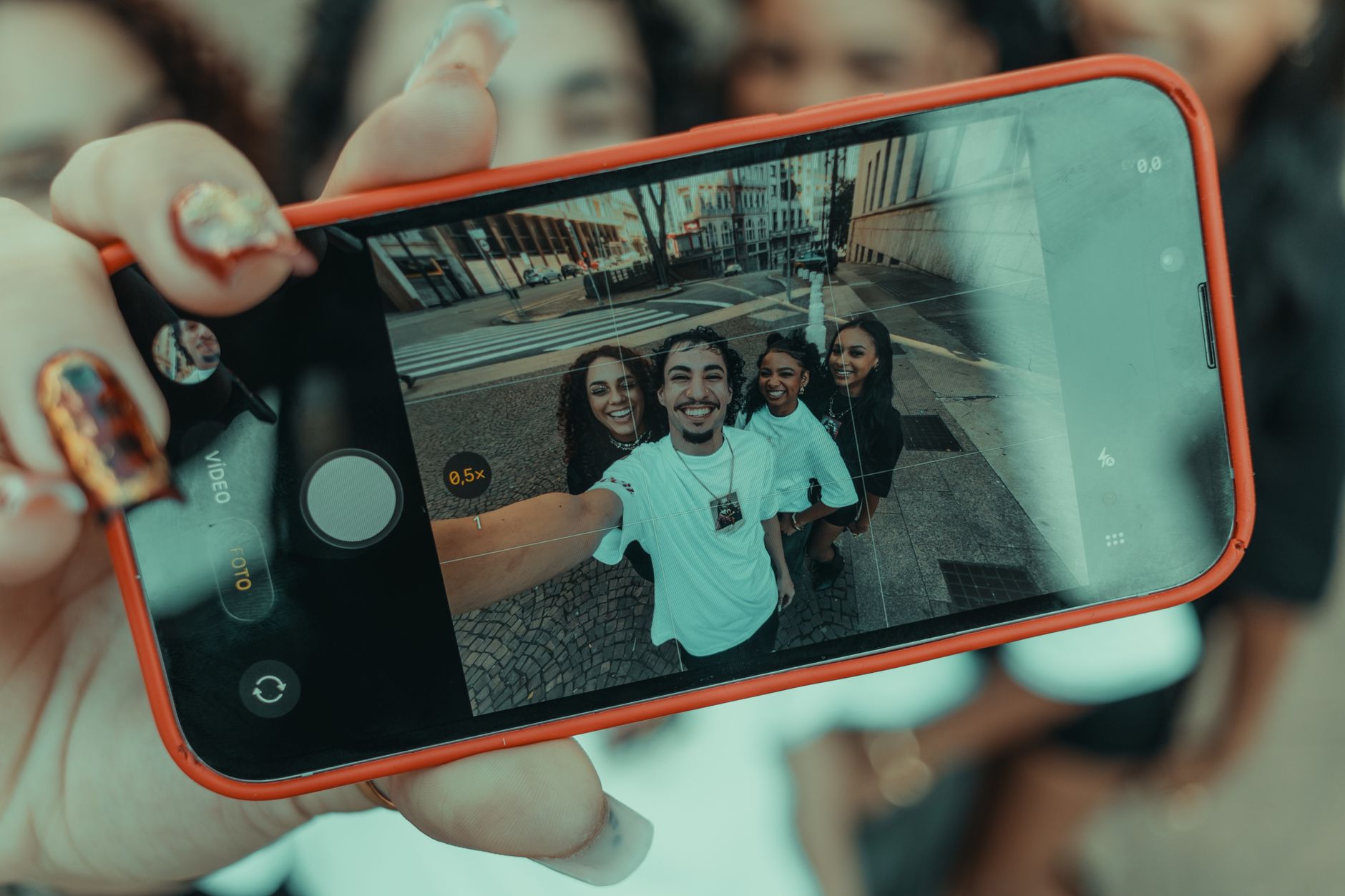
In short: You have seven years of school English behind you, a vocabulary app that congratulates you every morning, and you still can't hold three minutes of conversation with a native speaker. The problem is almost never vocabulary: it's actual speaking time. Random video chat offers something neither textbooks nor apps provide — human interlocutors, unpredictable, available at 11 p.m. on a Sunday, and free. But an unprepared session quickly boils down to ten "hellos" followed by ten disconnections. This guide explains how to turn the roulette into a method: choosing the right time slots, using country filters, preparing follow-up questions, and honestly assessing what this practice can and cannot do for you.
Why nearly every learner is missing spontaneous conversation
France's education statistics are well known and rarely flattering. The European SurveyLang study, followed by successive assessments from the Ministry of Education's Directorate of Evaluation, Forecasting and Performance (DEPP), regularly place French pupils near the bottom of the European rankings in listening and speaking — well below their results in reading comprehension. The finding is consistent: we read reasonably well, we speak poorly.
The reason is structural. In a class of thirty pupils, individual speaking time in a foreign language is measured in tens of seconds per hour. Learning apps, for their part, excel at vocabulary and spaced repetition, but rely on closed exercises where the expected answer is known in advance.
Yet language acquisition depends on what linguists, following Merrill Swain, call the output hypothesis: it is by producing language — and by stumbling over what you can't manage to say — that you identify your gaps and correct them. Stephen Krashen, meanwhile, popularised the notion of comprehensible input, exposure to language slightly above your own level. A video conversation with a stranger ticks both boxes at once.
There's a third factor, less theoretical: the emotional stakes. Speaking badly in front of a teacher or a colleague carries a real social cost. Speaking badly in front of a stranger 6,000 kilometres away, someone you'll never see again, costs nothing. That absence of consequence is precisely what unlocks speech.
What random video chat really delivers — and what it doesn't
Let's be clear before getting to the method: this is not a course. Here's an honest division of labour.
| What the roulette does well | What it will never do |
|---|---|
| Train comprehension of varied, non-textbook accents | Systematically correct your grammar |
| Get you used to speaking unprepared, in real time | Structure a progression by levels |
| Expose you to colloquial language, verbal tics and slang | Teach you new vocabulary in an organised way |
| Reduce speaking anxiety | Guarantee a friendly interlocutor |
| Provide unlimited, free practice volume | Give you written feedback on your mistakes |
The practical conclusion: use the roulette as a proving ground, not as a source of learning. The foundations — grammar, core vocabulary, phonetics — must come from elsewhere. A language course with audio CD or a conversation handbook remains the logical companion to this practice: it supplies the material, and the roulette forces you to produce it.
A sequencing tip: spend fifteen minutes revising a specific lexical field (work, food, travel, cinema), then start thirty minutes of chat, trying to steer every conversation towards that field. The reuse rate climbs dramatically compared with a session without a theme.
Choosing the platform and setting the filters
Not all platforms are equal for this purpose. Three criteria matter more than the rest.
The geographic or language filter. This is the decisive point. Without a filter, you get a distribution of global traffic that, depending on the platform, is dominated by a handful of countries and doesn't necessarily match your target language. Platforms offering country or language selection — often as a paid feature — radically change the yield of a session. Check before committing whether the filter is genuinely effective or merely indicative.
Parallel text mode. A text channel alongside the video is an underrated asset for learning: it lets your partner type out a word you didn't catch, and lets you jot down an expression on the fly. Many Omegle-derived platforms retain this dual window.
User density at your target hours. A platform can be excellent and deserted at the hour you log on. Think about time zones: if you're targeting North American English from France, connect between 9 p.m. and midnight Paris time (3 p.m.–6 p.m. on the East Coast). For Latin American Spanish, the same logic applies. For German, Dutch or Italian, French time slots work as they are, with a peak in the early evening.
A useful benchmark: Friday and Saturday evenings concentrate the highest traffic, but also the most inebriated and the least conducive to real conversation. Sunday afternoons and weekday evenings offer longer, calmer exchanges.
Check our platform comparison to identify those offering reliable country filtering — that's the setting that will make the difference between a wasted hour and an hour of genuine practice.
Preparing your session: equipment, setting, and five phrases
Sound before picture
In language learning, audio quality isn't a comfort, it's the very condition of the exercise. You need to distinguish a th from an s, hear a liaison, catch a swallowed word ending. A laptop microphone that picks up the fan and sends back echo makes all of that impossible and tires out your partner, who will hang up.
The minimum viable setup comes down to two things: a closed-back headset with microphone, which eliminates echo by stopping sound from looping back into the mic, and a room with little reverberation. If you practise more than two hours a week, a USB condenser microphone brings a clarity gain that is immediately noticeable in the average length of your conversations — people stay longer with someone they can hear clearly.
Lighting matters more than you'd think
This isn't vanity. In a foreign language, unconscious lip-reading provides considerable support for comprehension — that's the McGurk effect, documented since the 1970s. If your face is in shadow, your partner loses part of the information. A desk lamp pointed at your face, or a small LED ring light placed behind the screen, improves mutual understanding far more than it improves aesthetics.
The five phrases to know by heart
Prepare them in the target language and rehearse them until they're automatic. They rescue 80% of conversations that start badly.
- "I'm French, I'm learning [the language] — do you mind if we chat for a bit?" → clarifies your intention from the second second.
- "Sorry, could you repeat that more slowly?" → say it without shame, as often as needed.
- "How do you say…?" followed by the word in French or a description → the single most productive question of all.
- "What does that mean?" → use it as soon as a word comes up twice.
- "What have you been up to this week?" → an open-ended prompt, impossible to dispatch with a yes or no.
Keep a spiral notebook open beside the keyboard rather than a file on screen: writing down a word you've heard by hand, without taking your eyes off the conversation, works far better than switching between two windows. You'll go over it the next day.

The three-speed method
The main trap of the language roulette is expecting everything from every connection. Out of a hundred strangers, the vast majority will move on within three seconds — that's how these platforms normally work, not a judgement on you. So structure your session into three modes.
Speed 1 — filtering (0–5 seconds). You say hello in the target language and you observe. If the screen is black, if the person doesn't speak the language you're after, if the context is clearly inappropriate, you move on. Without hesitation and without counting it as a failure. Target: reach the next stage roughly one time in ten.
Speed 2 — the short exchange (30 seconds to 3 minutes). You state your intention, ask two questions, and listen. Many exchanges will stop there, and that's already useful: you'll have produced three or four spontaneous sentences and heard a real accent. Over a one-hour session, ten such exchanges are worth far more than a textbook drill.
Speed 3 — the long conversation (10 minutes and up). It happens once to three times per session if you're lucky. This is where real learning takes place: you go off-script, you get stuck, you rephrase, you learn words in context. When it happens, don't watch the clock. And if you really hit it off, suggest continuing on a dedicated language-exchange platform where you can reconnect — that's how genuine conversation partners are born.
Keeping a session log
Five lines after each session is enough: duration, number of speed-2 and speed-3 exchanges, three words or expressions you retained, one thing you couldn't manage to say. That last line is the most valuable — it's your revision list for the following week. A dedicated notebook, or a spaced-repetition app where you enter your finds, turns scattered conversations into measurable progress.
Safety and courtesy: the rules specific to this use
Practising a language exempts you from none of the usual precautions, and adds two.
- Don't confuse linguistic interest with romantic interest. A clear announcement — "I'm learning your language" — sets the frame. If your partner oversteps it, move on to the next one.
- Beware of requests to move off the platform. This is the classic scam vector: someone very charming, very patient with your accent, who quickly suggests another messaging app. The rule remains the one we repeat across this site: no personal data, no phone number, no social media in the early days.
- Watch your background. A bookshelf, a poster, a letter left on the desk say a great deal. A neutral background or a simple removable backdrop settles the matter for good.
- Respect the asymmetry of the exchange. If your partner is learning French, alternate: ten minutes in each language. That's the unspoken rule of language exchange, and it turns a favour into a genuine partnership.
- Accept correction — and ask for it. Many native speakers don't dare correct you out of politeness. One sentence is enough: "feel free to correct me, it helps."
Finally, remember that all these platforms state that access is restricted to adults, and that moderation remains uneven despite progress in automated systems. An underage learner should turn to supervised language-exchange platforms rather than the general-purpose roulette.

How long before you see a difference?
No study measures the specific effect of random video chat on language acquisition — the scientific literature covers structured telecollaboration and language tandems, not the roulette. Anecdotal reports nonetheless converge on an order of magnitude: three forty-five-minute sessions a week for two months is enough to bring down the psychological barrier to speaking up. Fluency, on the other hand, is built over months.
The most reliable marker of progress is neither vocabulary nor grammar: it's the delay before your first sentence. At the start, you take three or four seconds to put together a greeting. The day you reply without thinking, with the right tone, to someone who has just appeared on screen, something has changed for good.
And if you're aiming at an exam — TOEIC, Cambridge, DELE, Goethe-Zertifikat — bear in mind that this practice works precisely on the skill that is hardest to train alone. Combine it with an exam preparation book for your target test to cover the formal side: the two are complementary and don't replace each other.
Key takeaway: random video chat isn't a learning method, it's a gym. You don't discover the language there, you build muscle with it. Come prepared, accept that nine connections out of ten lead nowhere, and focus your attention on the tenth. That's the one that makes you better.